1st order dynamic system
Following the example of Prof. Cimbala ME 345 course
import numpy as np
import matplotlib.pyplot as plt
import matplotlib as mpl
mpl.rcParams['lines.linewidth']=2
mpl.rcParams['lines.color']='r'
mpl.rcParams['figure.figsize']=(10,12)
mpl.rcParams['font.size']=14
mpl.rcParams['axes.labelsize']=16
T = 1.
t = np.arange(0,10*T,.0001)
t_T = t/T

# Step function

# for a step function, take user input on final and initial values.
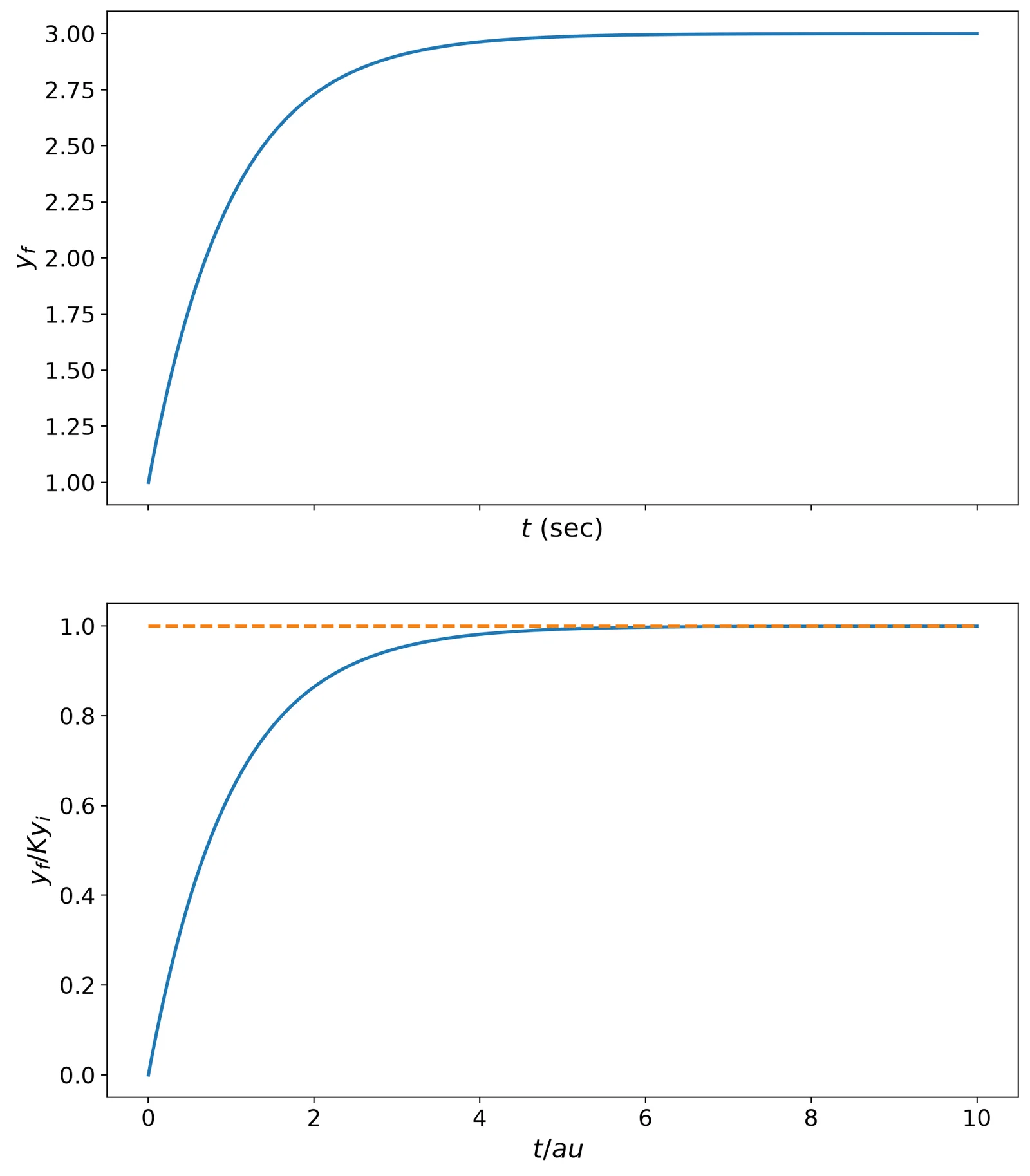
y_i = 1.0
y_f = 3.0

y_step_norm =  (1 - np.exp(-t_T))
y_step = (y_f-y_i)*y_step_norm + y_i
_fig, _ax = plt.subplots(nrows=2, sharex=True)
_ax[0].plot(t, y_step)
_ax[0].set_xlabel('$t$ (sec)')
_ax[0].set_ylabel('$y_f$')
_ax[1].plot(t_T, y_step_norm)
_ax[1].plot(t_T, np.ones(t_T.shape), '--')
_ax[1].set_xlabel('$t/\tau$ ')
_ax[1].set_ylabel('$y_f/Ky_i$')
plt.figure(figsize=(6, 5))
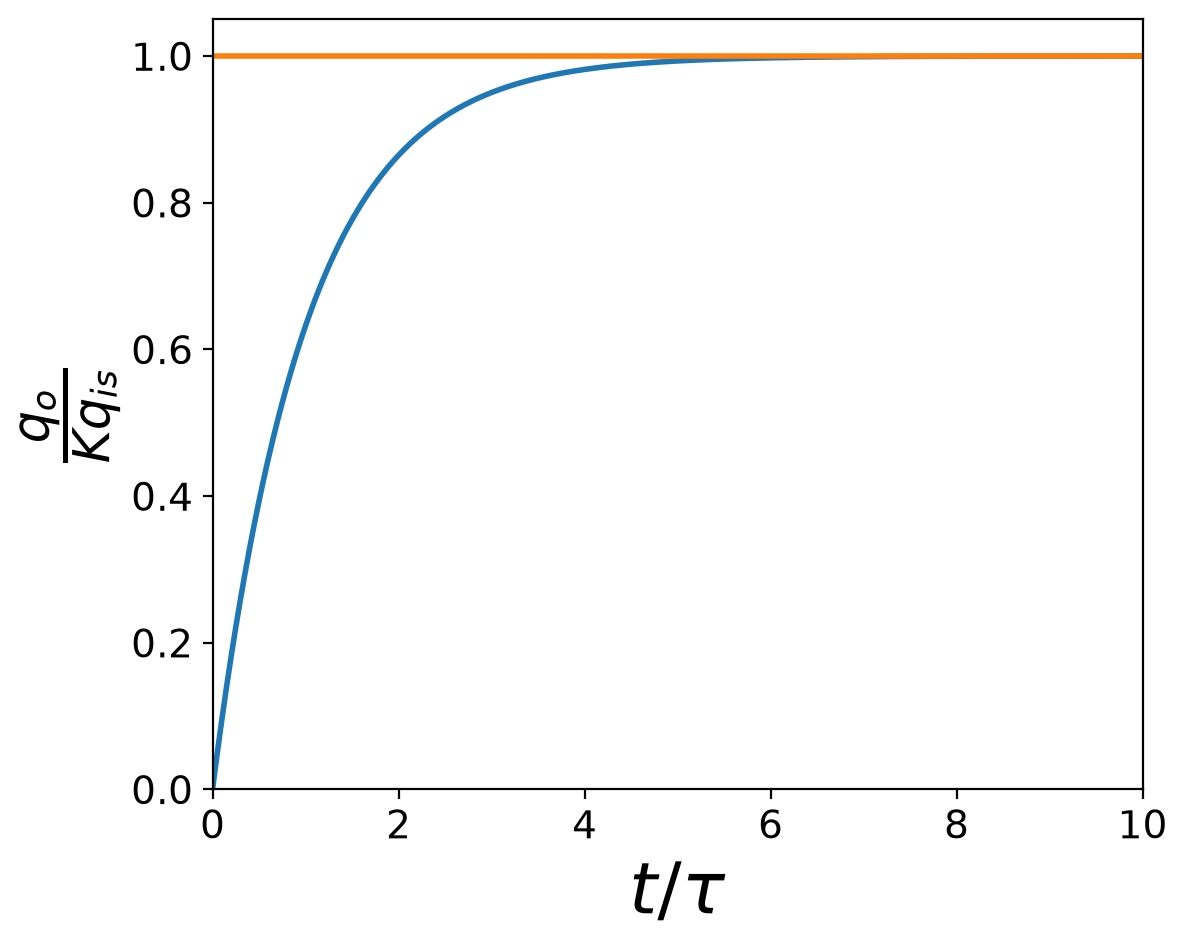
plt.plot(t_T, y_step_norm, lw=2)
plt.xlim(0, 10)
plt.ylim(0, 1.05)
plt.plot(t_T, np.ones(t_T.shape))
plt.ylabel('$\\frac{q_o}{Kq_{is}}$ ', fontsize=26)
# plt.savefig('1st_order_step_response.png',dpi=200)
plt.xlabel('$t/\\tau$', fontsize=26)
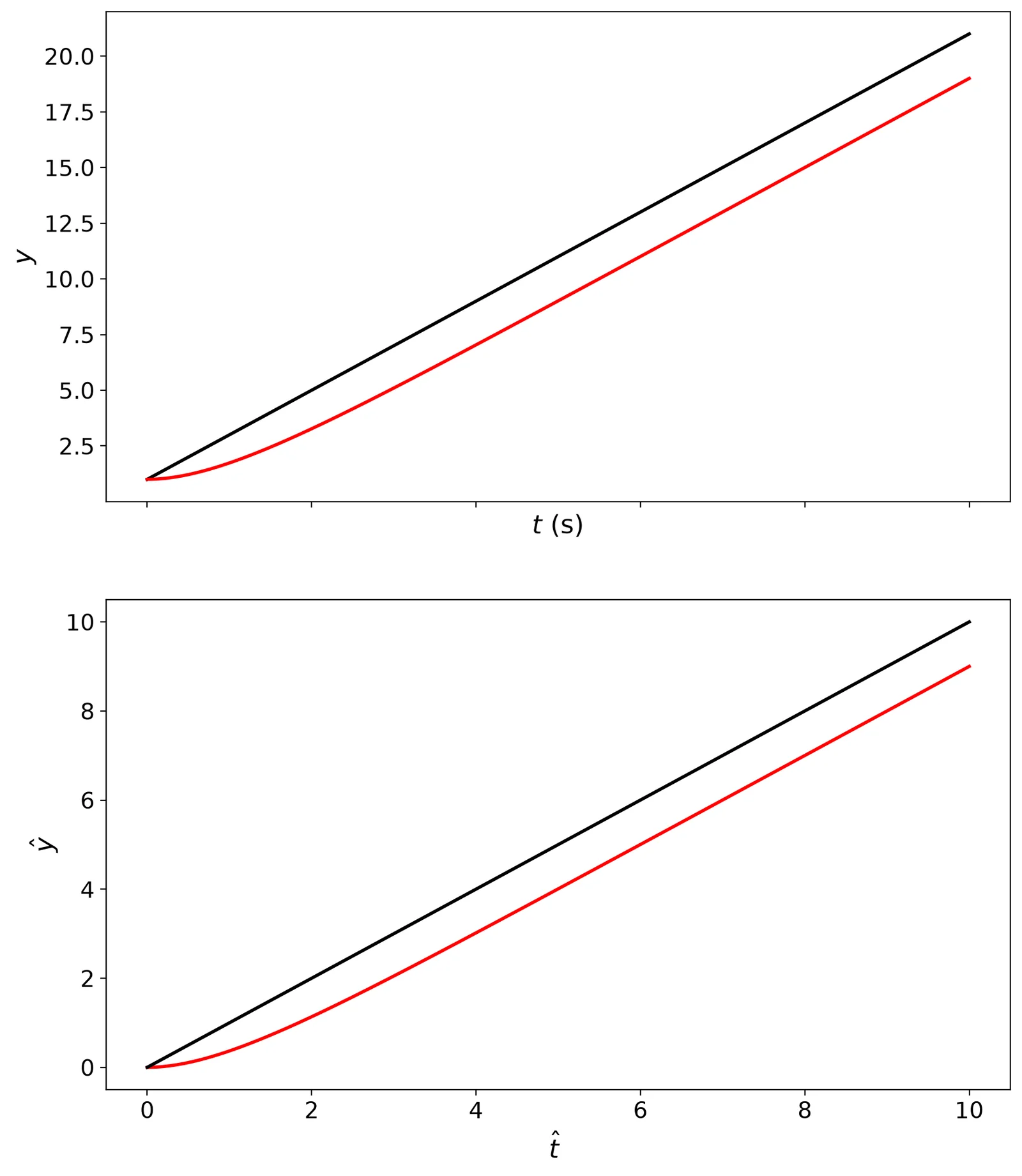
y_i_ramp = 1.0
A = 2.0
y_ideal_ramp = A * t + y_i_ramp
# determine actual ramp function.
y_ramp_norm = t - T * (1 - np.exp(-t_T))
y_ramp = A * y_ramp_norm + y_i_ramp
_fig, _ax = plt.subplots(nrows=2, sharex=True)
_ax[0].plot(t, y_ideal_ramp, 'k', t, y_ramp, 'r')
_ax[0].set_xlabel('$t$ (s)')
# figure(figsize=(10,8))
_ax[0].set_ylabel('$y$')
_ax[1].plot(t_T, y_ramp_norm, 'r', t_T, t, 'k')
_ax[1].set_xlabel('$\\hat{t}$ ')
_ax[1].set_ylabel('$\\hat{y}$')
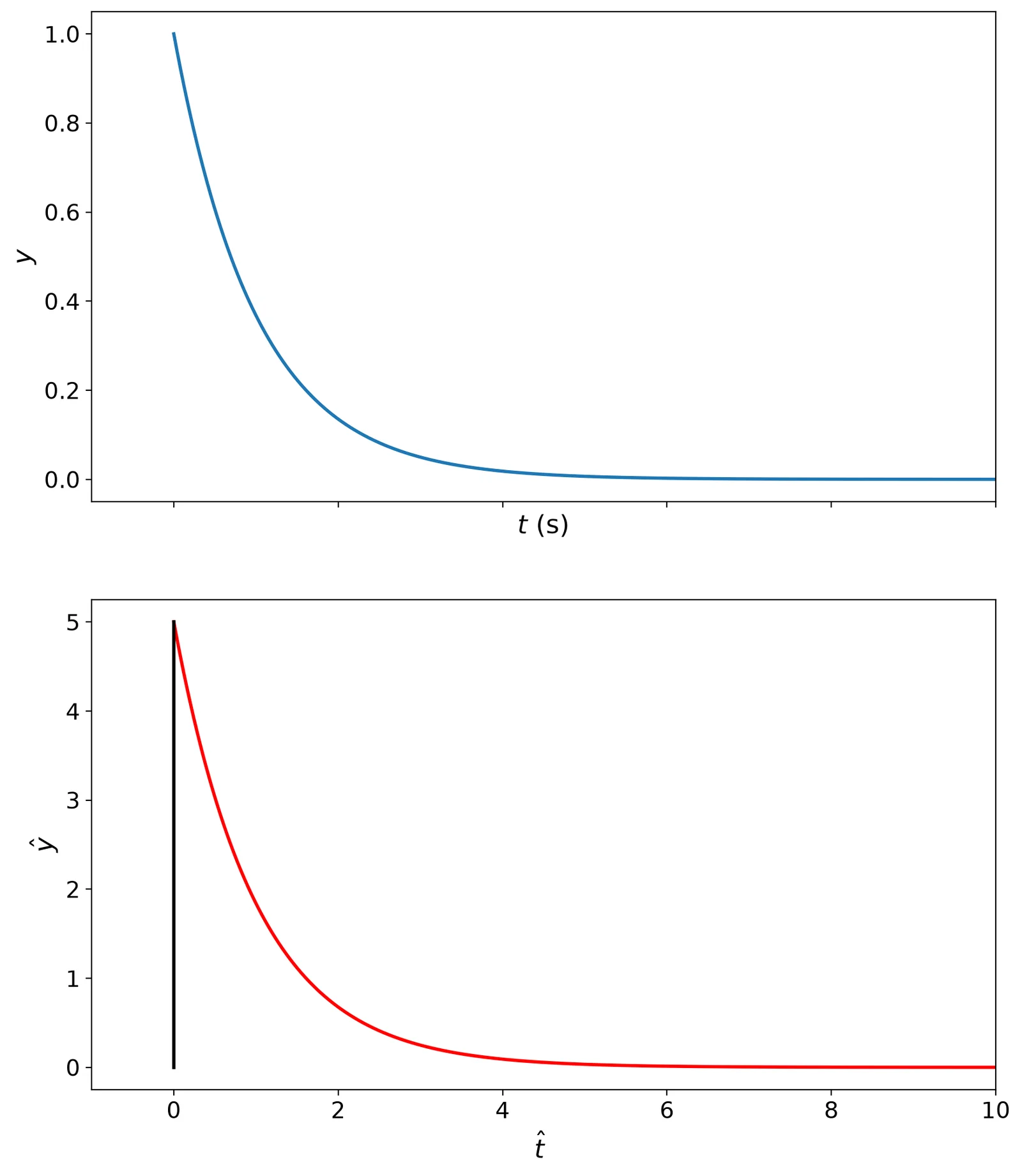
y_i_impulse = 0.;
y_f_impulse = 5.;

y_impulse_norm = (1./T)*np.exp(-t_T);
y_impulse = y_impulse_norm * (y_f_impulse-y_i_impulse) + y_i_impulse;
_fig, _ax = plt.subplots(nrows=2, sharex=True)
# figure(figsize=(10,8))
_ax[0].plot(t_T, y_impulse_norm)
_ax[0].set_xlabel('$t$ (s)')
_ax[0].set_ylabel('$y$')
_ax[1].plot(t, y_impulse, 'r', [0.0, 0.0], [y_i_impulse, y_f_impulse], 'k')
_ax[1].set_xlim([-T, 10 * T])
_ax[1].set_xlabel('$\\hat{t}$ ')
_ax[1].set_ylabel('$\\hat{y}$')