import numpy as np
import matplotlib.pyplot as pl
%matplotlib inline
from IPython.display import Image
im = Image('../img/pressure_calibration_table.png')
im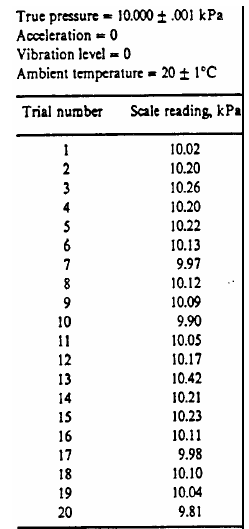
ptrue = 10.000
p = np.array([10.02, 10.20, 10.26, 10.20, 10.22, 10.13, 9.97, 10.12, 10.09, 9.9, 10.05, 10.17, 10.42, 10.21, 10.23, 10.11, 9.98, 10.10, 10.04, 9.81])
Let’s build histogram, we need to select the number of bins or
Recommendations for choice of the histogram size:
or number of bins shall be at least 5:
There are several different methods to estimate the right number of bins for the histogram:
or
histogram is defined as:
where bin size, total number of readings, is the number of readings in some bin, centered at
K = 1.87*(p.size - 1)**(0.4);
print (K)
K = np.sqrt(p.size);
print (K)
K = 9
dp = (np.max(p) - np.min(p))/K;
print (dp)
bins = np.r_[np.min(p)-dp:np.max(p)+dp:dp];
print (bins) # row vector
6.0721577674237
4.47213595499958
0.06777777777777771
[ 9.74222222 9.81 9.87777778 9.94555556 10.01333333 10.08111111
10.14888889 10.21666667 10.28444444 10.35222222 10.42 ]
hist, bin_edges = np.histogram(p,bins=bins)
hist
array([0, 1, 1, 2, 3, 5, 4, 3, 0, 1])pl.bar(bin_edges[:-1], hist, dp)<BarContainer object of 10 artists>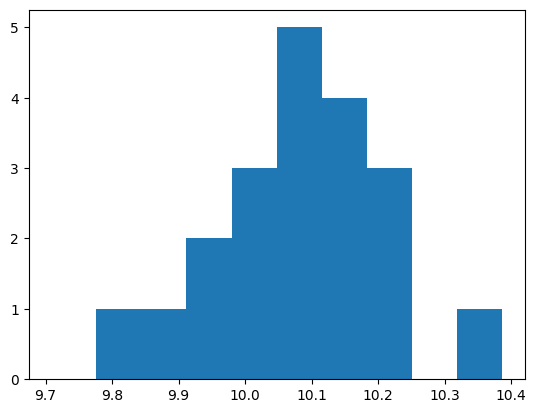
mu = np.mean(p)
sigma = np.std(p)
print( 'mean, std %3.2f, %3.2f' % (mu, sigma))
x = np.linspace(9.7,10.5,100)
gauss = 1./np.sqrt(2*np.pi*sigma**2)*np.exp(-((x-mu)**2/(2*sigma**2)))
mean, std 10.11, 0.13
pl.plot(bin_edges[:-1]+dp/2,hist,'bo',x,gauss,'r')
pl.ylim(0,3.5)
pl.xlim(9.5, 10.6)
(9.5, 10.6)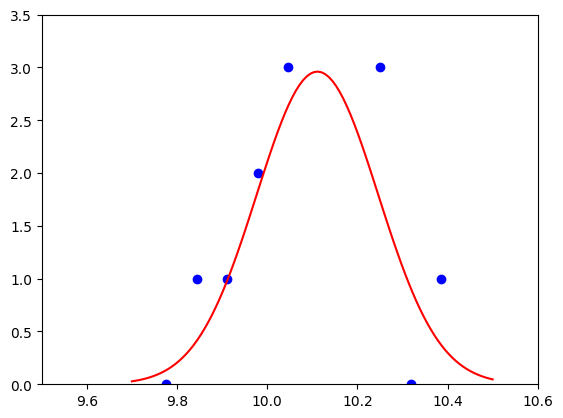
test
How do we check if our histogram is similar to the Gaussian (or any other) distribution? Goodness-of-fit is called the test
gauss = 1./np.sqrt(2*np.pi*sigma**2)*np.exp(-((bin_edges[:-1]+dp/2.-mu)**2/(2*sigma**2)))
chisq = np.sum((hist - gauss)**2/gauss)
print( '$\chi^2$ = %f' % chisq)
$\chi^2$ = 6.126602
# degrees of freedom = number of bins minus the (order of the fit + 1):
print ('Number of degrees of freedom,  K - (m+1) = %d' % (K - 2))
Number of degrees of freedom, K - (m+1) = 7
from scipy import stats
pval = 1 - stats.chi2.cdf(chisq, K-2);
print ('Confidence level is %3.1f percent' % (pval*100)  )
Image('../img/chi_square_graph.png')
Confidence level is 52.5 percent
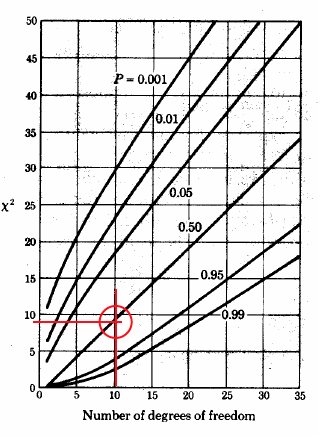
we conclude that for the given set of measurements we are only 50% certain that we can use the Gaussian distribution assumptions
Calibration
# Increasing pressure:
p_in_up = np.linspace(0.0,10.0,11)
p_out_up = np.array([-1.12, 0.21, 1.18, 2.09, 3.33, 4.50, 5.26, 6.59, 7.73, 8.68, 9.8])
# Decreasing pressure
p_in_down = np.flipud(p_in_up)
p_out_down = np.array([10.20, 9.10, 7.92, 6.89, 5.87, 4.71, 3.62, 2.48, 1.65, 0.42, -0.69])pl.plot(p_in_up,p_out_up,'bo',p_in_down,p_out_down,'rs')
pl.xlabel('Input pressure [kPa]')
pl.ylabel('Output pressure [kPa')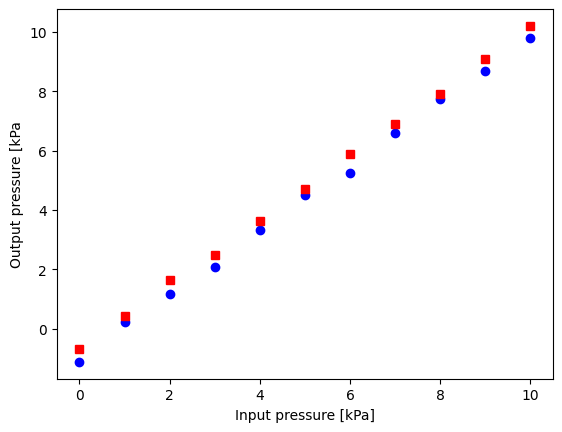
x = np.r_[p_in_up,p_in_down]
y = np.r_[p_out_up,p_out_down]np.polyfit(x,y,1)array([ 1.08231818, -0.84704545])Estimate uncertainty
We then use the inverse of the calibration curve to get the inputs from the outputs:
m = 1.08
b = -0.85
std_q0 = np.sqrt(1./(y.size-1) * np.sum((m*x + b - y)**2))
print( 'std(q_0) = %f ' % std_q0)
std(q_0) = 0.203727
# let's assume we measured output
q_0 = 4.32 #kPa
# we estimate the real input as:
q_i = (q_0 - b)/m

# and its std. dev.

std_qi = std_q0/m

print ('q_i = %3.2f +- %3.2f kPa ' % (q_i, 3*std_qi))
q_i = 4.79 +- 0.57 kPa
# we can visualize the result as:
# im = Image('../img/result_pressure_measurement.png'); im- sensitivity uncertainty
- zero shift uncertainty
kPa