A Federal Grade 2 accuracy gage block is used to calibrate the measurements of a micrometer. A gage block is a calibration standard for thickness measurement, it is a block of material, steel in this case, machined to a very high accuracy of thickness.
A Federal Grade 2 accuracy gage block is used, it meets certain tolerances for length, flatness and parallelism. Read more on https://
www .nist .gov /system /files /documents /calibrations /mono180 .pdf The calibrated accuracy of the micrometer can be no greater than the total error of this standard accuracy.
The total error from the calibration will be the root sum of the squares (RSS) of the bias and precision errors.
from IPython.display import Image
# Image('https://www.higherprecision.com/images/blog_images/higherprecision_gageblocks.jpg',width=500)
Image('https://cdn.mscdirect.com/global/media/images/tech-essentials/outside-micrometer.jpg')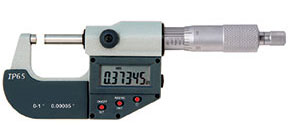
import numpy as npWe performed multiple measurements and checked that the histogram is close to normal distribution
Image('https://www.mathsisfun.com/data/images/histogram.gif')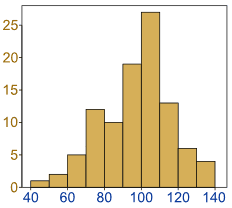
N = 40 # 40 measurements
mean_x = 0.12621 # inch
s_x = 0.000146317 # inch
t_39_95 = 2.02268893 # t-statistic for N-1 degrees of freedom
true_x = 0.12620 # inch - true value for calibration# bias error
e_bias = np.abs(mean_x - true_x)
print(f"Bias error = {e_bias:g} inch")Bias error = 1e-05 inch
# precision error
e_precision = t_39_95*s_x/np.sqrt(N)
print(f"Precision error = {e_precision:g} inch")
Precision error = 4.67944e-05 inch
# micrometer resolution
resolution = 0.00005 # inch

e_resolution = resolution/2
print(f"Resolution error = {e_resolution:g} inch")
Resolution error = 2.5e-05 inch
# Manufacturer supplied information about the gage
# accuracy. We have chosen only grade 2 accuracy ( higher more expensive )
e_standard_length = 4e-6 # inch
e_standard_flattness = 4e-6 # inch
e_standard_parallelism = 4e-6 # inch
e_standard_total = np.sqrt(e_standard_length**2  + e_standard_flattness**2 + e_standard_parallelism**2)
print(f"standard gage grade 2 error = {e_standard_total:g} inch")
standard gage grade 2 error = 6.9282e-06 inch
# note that even if we'd use an ideal measurement system with e = 0
# we will never get the true value as there uncertainty of the standard gage block itself

# note that standard gage block uncertainty is smaller than other values
# otherwise you need to choose a better grade of the gage block

e_calibration_total = np.sqrt(e_bias**2 + e_precision**2 + e_standard_total**2 + e_resolution**2)
print(f"Calibration error = {e_calibration_total:g} inch")Calibration error = 5.44308e-05 inch
# our accuracy measure is
accuracy = (1 - e_calibration_total/true_x)
print(f"Accuracy (relative) = {accuracy*100:.3f} %")
Accuracy (relative) = 99.957 %
# from this moment and on we can use the micrometer, but we have to use its # calibration error as a bias error for all the measurements
# remember that it already includes the resolution error, so don't repeat it.
Second half: use the calibrated micrometer to measure the diameter of a cylinder
Image('https://static1.bigstockphoto.com/8/3/3/large2/338282026.jpg')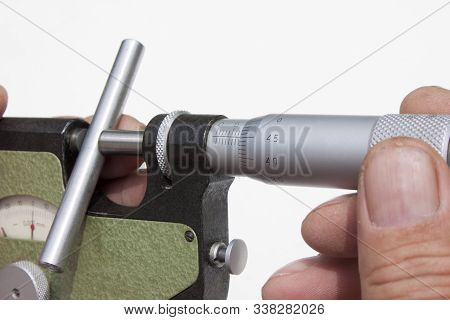
d_mean = 0.32512 # inch
N = 40
s_d = 0.0003 # inch

from scipy.stats import t as student_t
# for the 95 confidence level
confidence_level = 0.95 # 95%
alpha = 1 - confidence_level
degrees_of_freedom = N - 1
t_value = student_t.ppf(1-alpha/2.0, degrees_of_freedom)
print(f"t value = {t_value}")
t value = 2.0226909200367604
e_cylinder = np.sqrt( e_calibration_total**2 + t_value*s_d/np.sqrt(N))
print(f"e_cylinder = {e_cylinder:g} inch with 95% probability")
e_cylinder = 0.00979529 inch with 95% probability
e_cylinder/2np.float64(0.0048976427330861385)