based on lectures of Prof. Cimbala, ME341
The log-decrement method
The log-decrement is based on the following analysis:
and the damped natural frequency:
Using the output of the system in time (step function response) we need to solve for and simultaneously. The practical solution is the log-decrement method.
When , then the sine function is approximately and the magnitude only (peaks of the oscillating function) behave approximately as:
Therefore we plot the normalized step founction output minus 1, obtain a function that oscillates around zero, and try to extract the peaks. We can use only positive peaks and mark them as and their time instants, . From these values we can obtain:
The period of oscillations if we measure the time of cycles (e.g. in our example),
If we define the of the reduction of amplitude between each peak as :
, then the damping factor is recovered as:
and the rest is straightforward:
and
from IPython.core.display import Image
Image(filename='../img/log-decrement.png',width=600)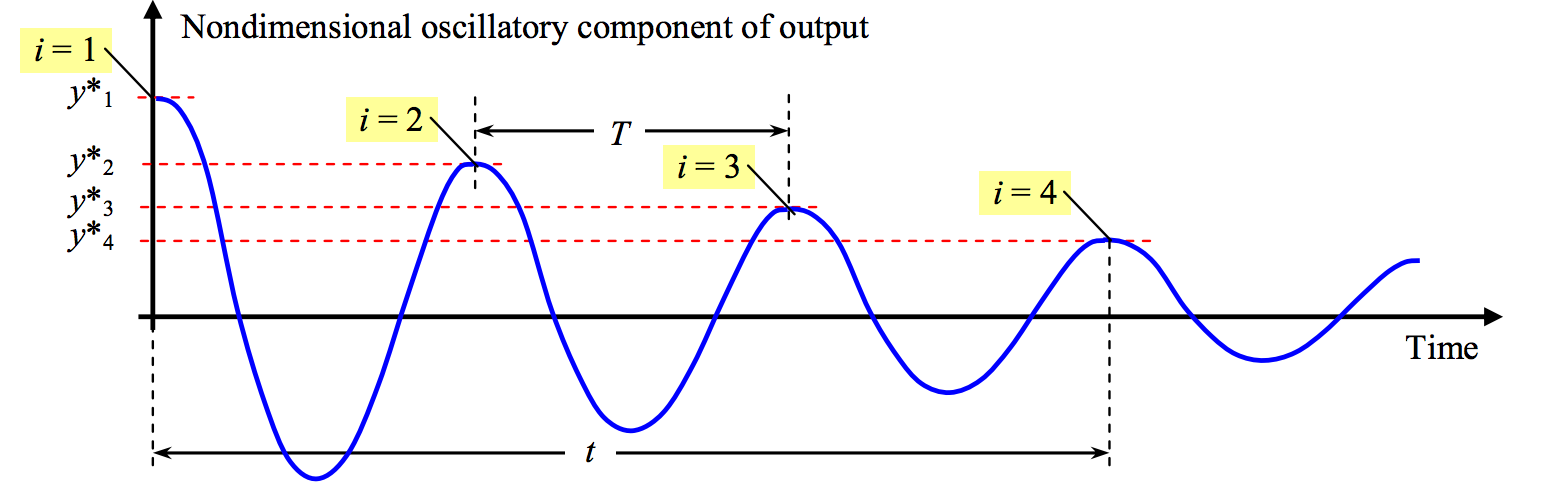
%pylab inline%pylab is deprecated, use %matplotlib inline and import the required libraries.
Populating the interactive namespace from numpy and matplotlib
/home/user/Documents/GitHub/mechanical-engineering-metrology-and-measurements/.venv/lib/python3.12/site-packages/IPython/core/magics/pylab.py:166: UserWarning: pylab import has clobbered these variables: ['sys']
`%matplotlib` prevents importing * from pylab and numpy
  warn("pylab import has clobbered these variables: %s"  % clobbered +
from scipy import signal

# Define transfer function
k = 1 		# sensitivity
wn = 546.72 # rad/s
z=0.2     # damping

sys = signal.lti(k*wn**2,[1,2*z*wn, wn**2])

# step function output
t,y = sys.step(N=1000)

plot(t,y)
title('Step response')
xlabel('$t$ [sec]')
ylabel('E [V]')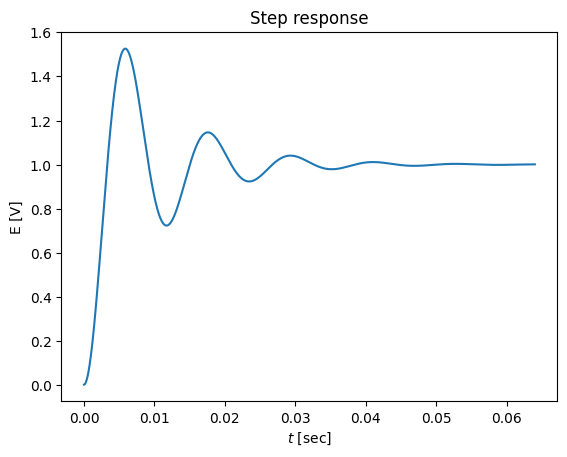
# note that sampling is sufficient, if not we need to apply the D/A reconstruction
# or interpolations, which will add more noise and uncertainty to the system identification
# plot the data as a decrement
ts = t[::15]
ys = y[::15]
plot(ts,ys-1,'o')
title('Step response')
xlabel('$t$ [sec]')
ylabel('E [V]')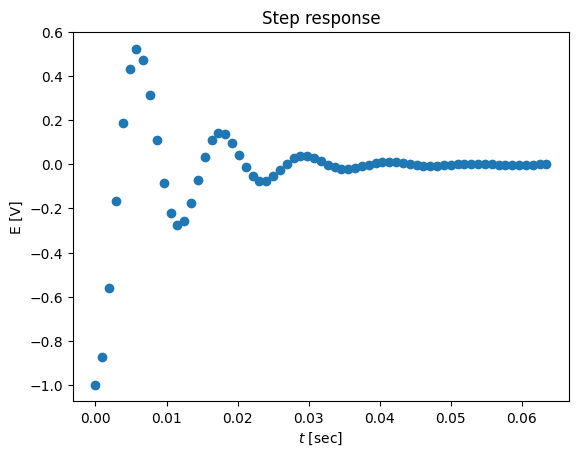
# we will use the open source peakdetect function from

def peakdet(v, delta, x = None):
    """
    Converted from MATLAB script at http://billauer.co.il/peakdet.html

    Returns two arrays

    function [maxtab, mintab]=peakdet(v, delta, x)
    %PEAKDET Detect peaks in a vector
    %        [MAXTAB, MINTAB] = PEAKDET(V, DELTA) finds the local
    %        maxima and minima ("peaks") in the vector V.
    %        MAXTAB and MINTAB consists of two columns. Column 1
    %        contains indices in V, and column 2 the found values.
    %
    %        With [MAXTAB, MINTAB] = PEAKDET(V, DELTA, X) the indices
    %        in MAXTAB and MINTAB are replaced with the corresponding
    %        X-values.
    %
    %        A point is considered a maximum peak if it has the maximal
    %        value, and was preceded (to the left) by a value lower by
    %        DELTA.

    % Eli Billauer, 3.4.05 (Explicitly not copyrighted).
    % This function is released to the public domain; Any use is allowed.

    """
    maxtab = []
    mintab = []

    if x is None:
        x = arange(len(v))

    v = asarray(v)

    if len(v) != len(x):
        sys.exit('Input vectors v and x must have same length')

    if not isscalar(delta):
        sys.exit('Input argument delta must be a scalar')

    if delta <= 0:
        sys.exit('Input argument delta must be positive')

    mn, mx = np.inf, -np.inf
    mnpos, mxpos = np.nan, np.nan

    lookformax = True

    for i in arange(len(v)):
        this = v[i]
        if this > mx:
            mx = this
            mxpos = x[i]
        if this < mn:
            mn = this
            mnpos = x[i]

        if lookformax:
            if this < mx-delta:
                maxtab.append((mxpos, mx))
                mn = this
                mnpos = x[i]
                lookformax = False
        else:
            if this > mn+delta:
                mintab.append((mnpos, mn))
                mx = this
                mxpos = x[i]
                lookformax = True

    return array(maxtab), array(mintab)

# if __name__=="__main__":
#     from matplotlib.pyplot import plot, scatter, show
#     series = [0,0,0,2,0,0,0,-2,0,0,0,2,0,0,0,-2,0]
#     maxtab, mintab = peakdet(series,.3)
#     plot(series)
#     scatter(array(maxtab)[:,0], array(maxtab)[:,1], color='blue')
#     scatter(array(mintab)[:,0], array(mintab)[:,1], color='red')
#     show()
maxtab, mintab = peakdet(ys-1,.01,ts)# we need only positive peaks, maxima:
maxtabarray([[0.0057674 , 0.52586962],
[0.0173022 , 0.14414951],
[0.02979824, 0.03919356],
[0.04133304, 0.01110418]])# We see 4 peaks and therefore n = 4
tstar = maxtab[:,0]
ystar = maxtab[:,1]
# plot the data with the peaks
plot(ts,ys-1,'x',tstar,ystar,'ro',markersize=8)
title('Step response')
xlabel('$t$ [sec]')
ylabel('E [V]')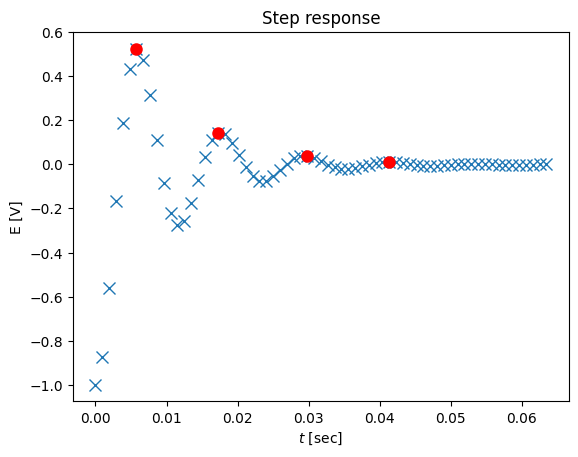
n = len(tstar)-1
print("cycles = %d" % n)
cycles = 3
T = (tstar[-1] - tstar[0])/(n)
print ("period T= %4.3f sec" % T)
period T= 0.012 sec
# delta
d = log(ystar[0]/ystar[-1])/(n)
print ("delta = %4.3f " % d)
delta = 1.286
# recover the damping and the frequency:
zeta= d/(sqrt((2*pi)**2 + d**2))
omegad = 2*pi/T
omegan = omegad/(sqrt(1-zeta**2))
# output
print ("natural frequency = %4.3f" % omegan)
print ("damping factor = %4.3f" % zeta)
print ("compare to the original: 546.72, 0.2")
natural frequency = 540.979
damping factor = 0.201
compare to the original: 546.72, 0.2